

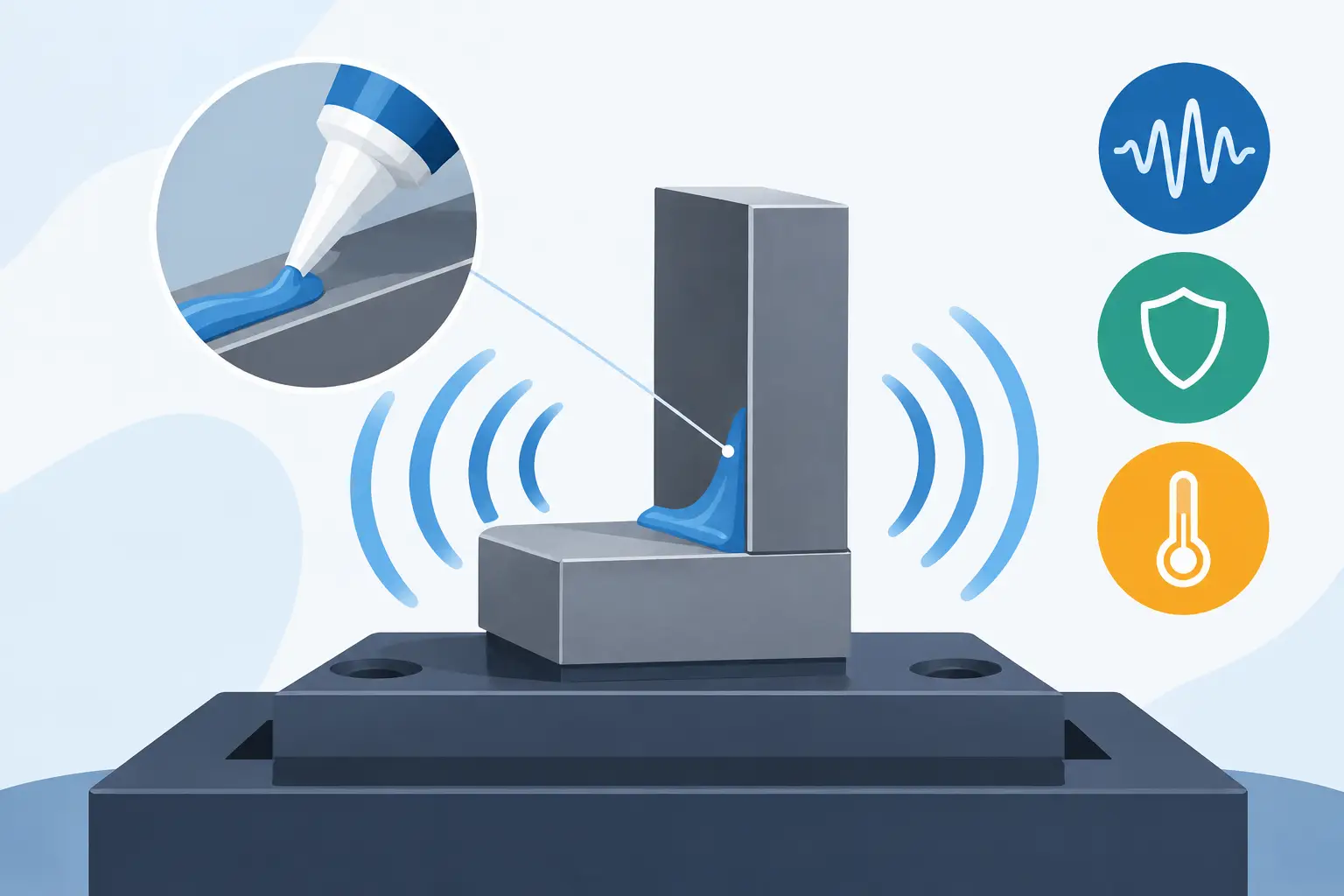
Can Adhesives Withstand Vibration? What Matters
A pump housing that loosens after months of cycling, an HVAC bracket that starts to rattle, or a vehicle trim panel that separates on a rough road all raise the same practical question: can adhesives withstand vibration? In many applications, they can perform extremely well. But vibration resistance is not a property that comes from adhesive strength alone. It depends on the full bonded assembly – adhesive chemistry, joint geometry, substrate preparation, cure conditions, operating loads, and the environment around the joint.
For contractors, maintenance teams, manufacturers, and procurement managers, the right decision is not simply choosing the strongest adhesive on a data sheet. It is selecting a bonding system engineered to manage movement over the service life of the part.
Can Adhesives Withstand Vibration in Real Equipment?
Yes. Properly selected structural adhesives, flexible sealants, and industrial tapes can withstand repeated vibration and help distribute loads more effectively than spot welds, screws, or rigid mechanical fasteners in certain assemblies. Adhesives create a continuous bond line rather than concentrating force at drilled holes or individual fastener locations. This can reduce local stress and help control noise, vibration, and harshness.
The qualification is critical: an adhesive must be matched to the movement it will experience. A rigid, high-strength formulation may perform well on a stiff metal assembly with minimal deflection. The same product can crack or lose adhesion when used between materials that expand differently, flex repeatedly, or operate near a vibration source.
Vibration is also rarely a single condition. Equipment may see low-frequency movement from a motor, high-frequency oscillation from rotating parts, shock from transport, thermal cycling, moisture, chemicals, and sustained mechanical load at the same time. A bond that survives one of these conditions in isolation may not survive their combined effect.
Why Vibration Causes Adhesive Bond Failures
Vibration creates repeated stress cycles in the adhesive layer and at the interface between the adhesive and substrate. Even when each individual movement is small, thousands or millions of cycles can create fatigue damage. Small cracks can initiate at a joint edge, around a void, or at a poorly prepared surface. Once a crack begins, each cycle can extend it until the bond loses its load-bearing capacity.
The most common failure modes are cohesive failure, adhesive failure, and substrate failure. Cohesive failure occurs within the adhesive itself, often when the material is too brittle or the bond line is too thin for the movement involved. Adhesive failure occurs at the substrate interface and is commonly linked to contamination, inadequate surface preparation, incompatible materials, or moisture exposure. Substrate failure means the adhesive remains bonded while the base material tears or delaminates – usually a positive sign for bond strength, though the assembly still needs a stronger material solution.
Heat can accelerate all three. A vehicle component bonded near an engine bay, for example, may face vibration while the adhesive softens at elevated temperatures. In outdoor construction or rooftop HVAC work, thermal expansion and contraction add movement to wind-induced vibration. The operating temperature range matters as much as the initial room-temperature bond strength.
Adhesive Chemistry Changes the Result
Different adhesive families manage vibration differently. The selection should begin with the joint’s expected movement, temperature range, substrate materials, cure window, and exposure conditions.
Flexible sealants and elastomeric adhesives
Polyurethane, hybrid polymer, and certain silicone-based products are often selected where movement accommodation is a priority. Their elasticity allows the cured bond line to deform and recover as components vibrate, expand, or contract. These materials are valuable for panels, ducting, construction joints, vehicle body components, and assemblies where sealing and bonding must work together.
Their trade-off is that they may not deliver the same rigid load transfer as a structural epoxy in a highly loaded metal-to-metal joint. Their performance also depends on correct joint dimensions. A flexible material placed in an excessively thin bond line can be restricted from moving as designed.
Structural epoxies and acrylics
Epoxy and methyl methacrylate adhesives can provide high strength and excellent load distribution on metals, composites, and selected plastics. Toughened structural grades are formulated to resist crack growth and can perform well under dynamic loading when the joint is designed correctly.
However, not every structural adhesive is equally fatigue-resistant. Standard rigid epoxies may be vulnerable in joints that flex continuously or experience impact. For vibration-critical equipment, a toughened or flexible structural formulation is often a better fit than selecting solely by tensile or lap-shear strength.
Cyanoacrylates and fast-setting products
Instant adhesives are useful for close-fitting parts, small repairs, and quick assembly tasks. Many standard grades cure hard and have limited tolerance for peel, impact, and repetitive movement. In vibration-prone assemblies, they are usually best reserved for low-load parts or used with a purpose-designed flexible grade and proper joint support.
Industrial tapes
High-performance acrylic foam tapes can provide strong, continuous bonding while damping vibration between panels and dissimilar materials. They are especially useful where drilling is undesirable, corrosion around fasteners is a concern, or a clean finished surface is required. Tape performance depends heavily on pressure during application, dwell time, surface energy, temperature, and edge sealing in wet or dusty service conditions.
Joint Design Is Often the Deciding Factor
A premium adhesive cannot compensate for a poor joint design. Vibration-loaded bonds should be designed to place the adhesive primarily in shear or compression, not peel or cleavage. Shear spreads force across the bonded area. Peel concentrates force at one advancing edge and can rapidly start a failure.
A wide overlap joint generally performs better than a narrow bond line carrying the same load. Adding bonded area reduces stress, but only if the assembly remains stiff enough to prevent peeling at the edges. For panels and brackets, flanges, returns, ribs, or mechanical stops may be used to control flex and protect the adhesive from direct peel loads.
Bond-line thickness also requires attention. Every adhesive has an effective thickness range. A bond line that is too thin may not absorb movement. One that is too thick may reduce strength, cure unevenly, or allow excessive deformation. Spacers, beads, tape thickness, or controlled application methods help maintain consistency during production and field installation.
When joining dissimilar substrates, allow for differential thermal movement. Aluminum, steel, glass, plastics, and composites expand at different rates. An adhesive with suitable elongation and fatigue resistance can manage that mismatch better than a rigid material, particularly across long bonded sections.
Surface Preparation and Cure Cannot Be Treated as Secondary
Many vibration failures begin before the adhesive is applied. Oil, dust, release agents, oxidation, moisture, and old sealant residue create weak boundary layers that may hold temporarily but separate under cycling. Clean, dry, stable surfaces are the starting point for dependable adhesion.
The preparation method should match the substrate. This may involve solvent cleaning, abrasion, dust removal, primer use, or activation for low-surface-energy plastics. The goal is not simply a visibly clean surface. It is a surface that allows the adhesive to form a durable bond at the molecular level.
Cure conditions are equally important. Temperature, humidity, joint depth, mixing ratio, and clamp time can all affect final properties. A product placed into vibration service before reaching its specified handling or full-cure condition may deform, shift, or develop early fatigue damage. On production lines and job sites, cure time must be built into the process rather than treated as an optional delay.
How to Specify an Adhesive for Vibration Service
A practical specification should define the application rather than rely on a general claim of vibration resistance. Procurement teams and engineers should ask suppliers for performance data relevant to the actual assembly, including temperature exposure, substrate combination, movement level, load direction, chemical contact, and expected service life.
Before approving a product, confirm these operating conditions:
- The joint is loaded mainly in shear or compression, with peel minimized.
- The adhesive retains suitable flexibility or toughness across the full service temperature range.
- Surface preparation, primer requirements, application thickness, and cure conditions can be controlled consistently.
- The assembly has been tested under representative vibration, shock, thermal cycling, and environmental exposure.
Laboratory test values are useful for comparing products, but representative assembly testing provides the strongest evidence. A lap-shear number alone does not predict performance on a vibrating enclosure, a rooftop unit, a vehicle panel, or a production fixture. Test the actual substrates, bond geometry, cure process, and expected load direction whenever the cost of failure is high.
Where Adhesives Add Value in Vibration-Prone Work
In automotive applications, adhesives can bond trim, panels, housings, and components while reducing stress concentrations and controlling rattle. In MEP and HVAC installation, they can support vibration-damping connections, seal joints, and bond insulation or accessories where mechanical fastening alone could create noise paths or air-leak risks.
For industrial manufacturing and maintenance, adhesives are often used to secure guards, panels, labels, fixtures, mounts, and protective elements. They can also complement mechanical fasteners rather than replace them entirely. A hybrid approach may be the safest choice for heavily loaded equipment: fasteners provide immediate retention and serviceability, while adhesive distributes load, seals interfaces, and reduces fretting movement.
The Engineer product range is built around this practical principle: material performance must match the working environment. The right formulation, applied under controlled conditions, helps reduce rework, unplanned downtime, and premature joint failure.
For any vibration-critical bond, start with the assembly rather than the adhesive tube. Define how the parts move, where stress concentrates, what temperature and contaminants the joint will face, and how the installation team can repeat the process. That discipline turns adhesive selection from a short-term fix into a dependable engineering decision.


Leave a Reply