

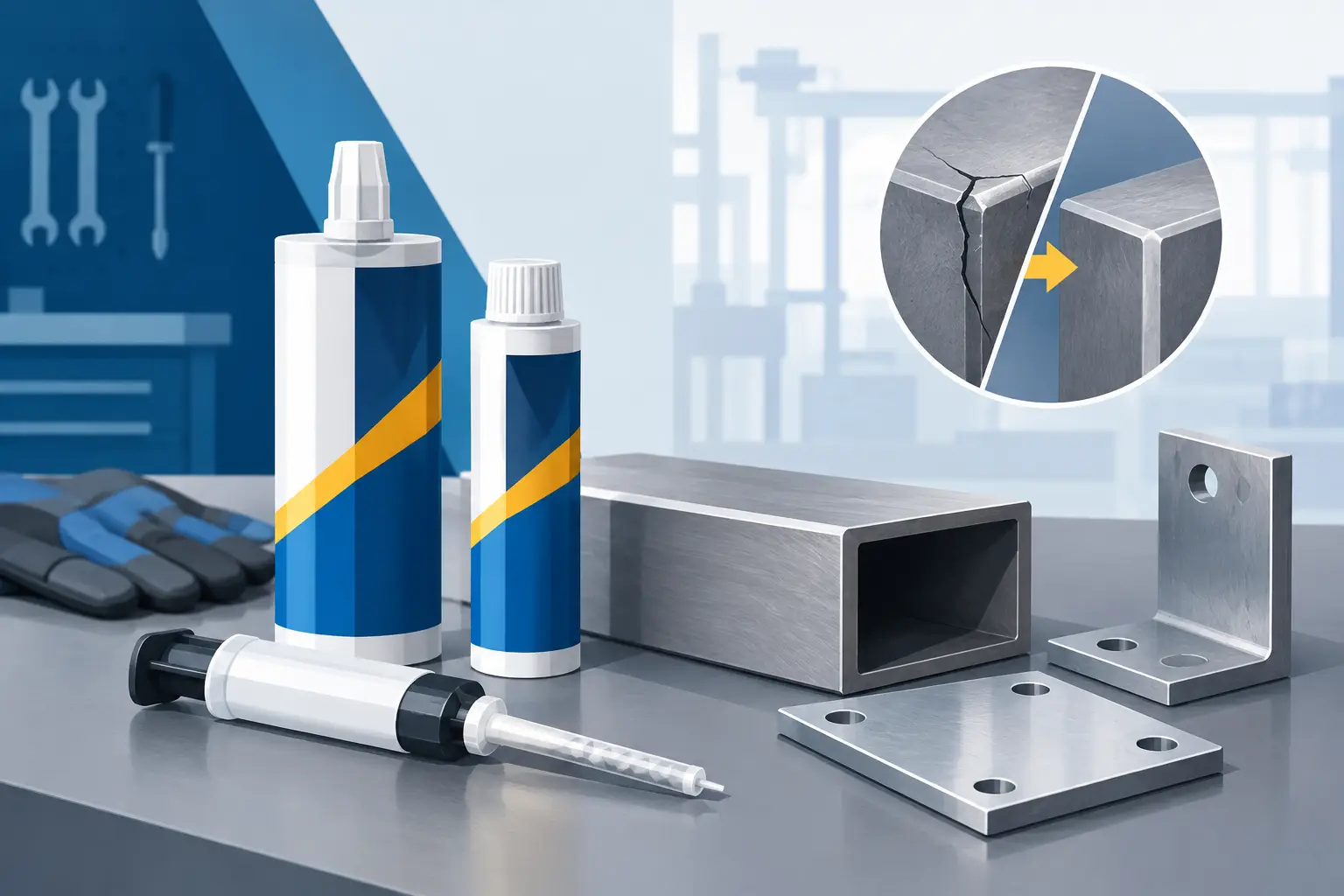
Best Metal Adhesives for Industrial Repairs
A failed metal bond rarely fails at a convenient time. It shows up as a loose bracket on a production line, a leaking threaded fitting, a vibrating vehicle panel, or an HVAC component that needs repair before downtime expands. The best metal adhesives are selected for the joint, the metal, the working environment, and the load – not simply for the highest number printed on a package.
For professional maintenance, fabrication, construction, automotive, and MEP work, adhesive selection is a performance decision. The right formulation can distribute stress across a wide bond area, seal against moisture, reduce corrosion points created by mechanical fasteners, and support faster repairs. The wrong product can leave a joint brittle, weak under heat, or unable to tolerate vibration.
Best Metal Adhesives by Application
There is no single adhesive that is best for every metal bonding job. Epoxy is often the first choice for structural repairs and gap filling. Methyl methacrylate and other structural acrylics perform well where difficult surfaces, impact resistance, and production speed matter. Polyurethane offers flexibility for assemblies that move or expand. Anaerobic products are purpose-built for threaded metal fasteners, cylindrical retaining, and flange sealing.
The practical question is not, “Which adhesive is strongest?” It is, “Which chemistry will maintain strength in this joint after exposure to actual service conditions?” Heat, oil, water, vibration, joint clearance, surface condition, and cure time all affect the answer.
Epoxy adhesives for structural repairs
Two-part epoxy adhesives are widely used for metal repair, fabrication, brackets, housings, and assemblies that need high compressive and shear strength. They bond well to steel, aluminum, cast iron, brass, copper, and many coated metal surfaces when preparation is correct. Their gap-filling capability is particularly useful when parts are not perfectly matched.
Epoxy is a strong option for rebuilding damaged metal surfaces, bonding stiff components, and repairing non-flexing parts. Metal-filled epoxy systems can also support rebuilding work on worn casings, cracked covers, and damaged equipment components where machining or welding is not practical.
The trade-off is rigidity. A hard epoxy may not be the right choice for thin metal panels that flex repeatedly, or for joints exposed to significant thermal movement. Cure speed also varies. Fast-setting grades support urgent repairs, while slower-cure systems often provide more working time and may develop stronger final performance.
Structural acrylic adhesives for demanding assemblies
Structural acrylic adhesives, including methyl methacrylate formulations, are designed for high-strength bonding with strong resistance to impact and peel forces. They are a practical choice for metal fabrication, transportation equipment, composite-to-metal assemblies, and production environments where surface preparation cannot always be perfect.
These adhesives can tolerate a wider range of surface conditions than many traditional epoxies. That does not mean preparation can be ignored. Oil, dust, oxidation, and loose coating still reduce bond quality. However, acrylic chemistry can provide reliable results on metals where light surface contamination or challenging substrates make other systems less forgiving.
Acrylic adhesives usually have a noticeable odor and require controlled handling. Procurement teams should consider ventilation requirements, packaging format, open time, and the expected assembly rate before standardizing a product for workshop or production use.
Polyurethane adhesives for flexible metal bonds
Polyurethane adhesives are appropriate when a bond must move without cracking. They are commonly used in construction, panel bonding, vehicle body applications, HVAC installation, and assemblies that experience vibration, thermal expansion, or weather exposure.
Compared with epoxy, polyurethane generally delivers lower structural stiffness but better flexibility. This makes it valuable for bonding dissimilar materials such as painted metal to plastic, glass, wood, or composites. It can also help absorb vibration that might concentrate stress around a rigid bond line.
Not every polyurethane is intended for high-load structural use. Product selection should confirm temperature resistance, cure mechanism, paintability, UV exposure capability, and compatibility with the materials being bonded. For exterior applications, long-term resistance to sun, rain, and temperature cycling deserves the same attention as initial bond strength.
Anaerobic adhesives for threads, shafts, and flanges
Anaerobic adhesives cure in the absence of air between close-fitting metal parts. They are not general-purpose surface bonding products. Their strength is in retaining cylindrical assemblies, locking threaded fasteners, sealing pipe threads, and sealing rigid flanges.
Threadlockers help resist loosening caused by vibration. Retaining compounds secure bearings, bushings, gears, and shafts, including some assemblies with minor wear or clearance. Thread sealants reduce the risk of fluid or gas leakage from threaded metal connections. Gasket makers form chemical-resistant seals between machined flanges.
Using anaerobic products correctly depends on fit and cleanliness. They perform best in confined metal joints. Large gaps, passive metals, low temperatures, and heavily oiled surfaces may require a compatible activator or a different adhesive system.
How to Select the Best Metal Adhesives for the Job
Start with the joint design. A broad lap joint generally allows an adhesive to perform far better than a peel-loaded edge joint. Adhesives distribute load across an area, while sharp edges and concentrated peel forces can initiate failure. If the joint can be redesigned, adding overlap, increasing bonded area, or using a mechanical feature to reduce peel stress can improve reliability before adhesive selection even begins.
Then identify the metal and its surface condition. Mild steel, stainless steel, aluminum, galvanized steel, copper, brass, and cast iron do not behave identically. Aluminum develops an oxide layer quickly. Stainless steel can be difficult for some cure systems. Galvanized and painted surfaces may require testing because the adhesive is only as dependable as the coating beneath it.
Environmental exposure is the next filter. A bond inside a climate-controlled enclosure has different demands from one exposed to engine heat, washdown chemicals, salt spray, outdoor weather, or continuous vibration. For a maintenance repair near heat sources, verify the adhesive’s continuous service temperature rather than relying only on short-term temperature claims.
Finally, match the product to production reality. A two-part adhesive with a 30-minute working time may be ideal for a large fabricated assembly but inefficient for a quick field repair. A five-minute product may return equipment to service quickly but leave limited time to align large parts. Cure time, fixture time, cartridge format, and storage conditions all affect cost and consistency at the job level.
Surface Preparation Determines Bond Strength
Even premium adhesive chemistry cannot compensate for a surface covered in oil, corrosion, dust, or weak paint. Preparation is where dependable metal bonding begins.
Remove grease and contaminants with a suitable cleaner, then allow the surface to dry completely. Abrade smooth metal with sanding, grinding, or another appropriate mechanical method to create a clean, fresh profile. Remove the resulting dust before applying adhesive. On heavily corroded metal, continue until sound substrate remains. Bonding to rust or loose coating only creates a failure point below the adhesive.
Dry-fit components before dispensing product. Confirm alignment, clamp access, bond-line thickness, and working time. Apply enough adhesive to achieve full wet-out across the joint, but avoid starving the bond line by clamping with excessive force. Follow the specified fixture and full-cure times. A part that feels secure after initial set may still be far from its final chemical and mechanical performance.
Avoid These Common Metal Bonding Failures
The most common error is selecting by advertised strength alone. Tensile or shear data can be useful, but test results are generated under specific conditions. They do not automatically predict performance on an oily, vibrating, outdoor assembly with uneven joint clearance.
Another frequent issue is using adhesive as a substitute for sound repair practice. If a component is severely distorted, heavily corroded, or carrying loads beyond the adhesive’s design range, welding, mechanical fastening, replacement, or a redesigned joint may be necessary. Adhesives are engineered solutions, not a cure for every failed component.
It is also risky to mix products without confirming compatibility. A sealant, primer, paint, cleaner, or thread treatment can interfere with adhesion or curing. Standardizing proven systems reduces variation across crews, shifts, and locations.
Build a Reliable Adhesive Standard
For procurement and maintenance teams, the best approach is to standardize a focused adhesive range around recurring jobs: structural repair, flexible panel bonding, threadlocking, retaining, and sealing. This gives technicians clear product choices while reducing excess inventory and application mistakes.
The Engineer performance-focused adhesive solutions are built for professional environments where dependable supply and consistent application results matter. When evaluating any range, look beyond the initial bond. Confirm technical fit, packaging practicality, service resistance, shelf-life control, and the supplier’s ability to support repeat requirements.
A metal bond should do more than hold parts together at installation. It should continue performing through vibration, heat, moisture, chemicals, and daily operating pressure – exactly where professional work is judged.

Leave a Reply