

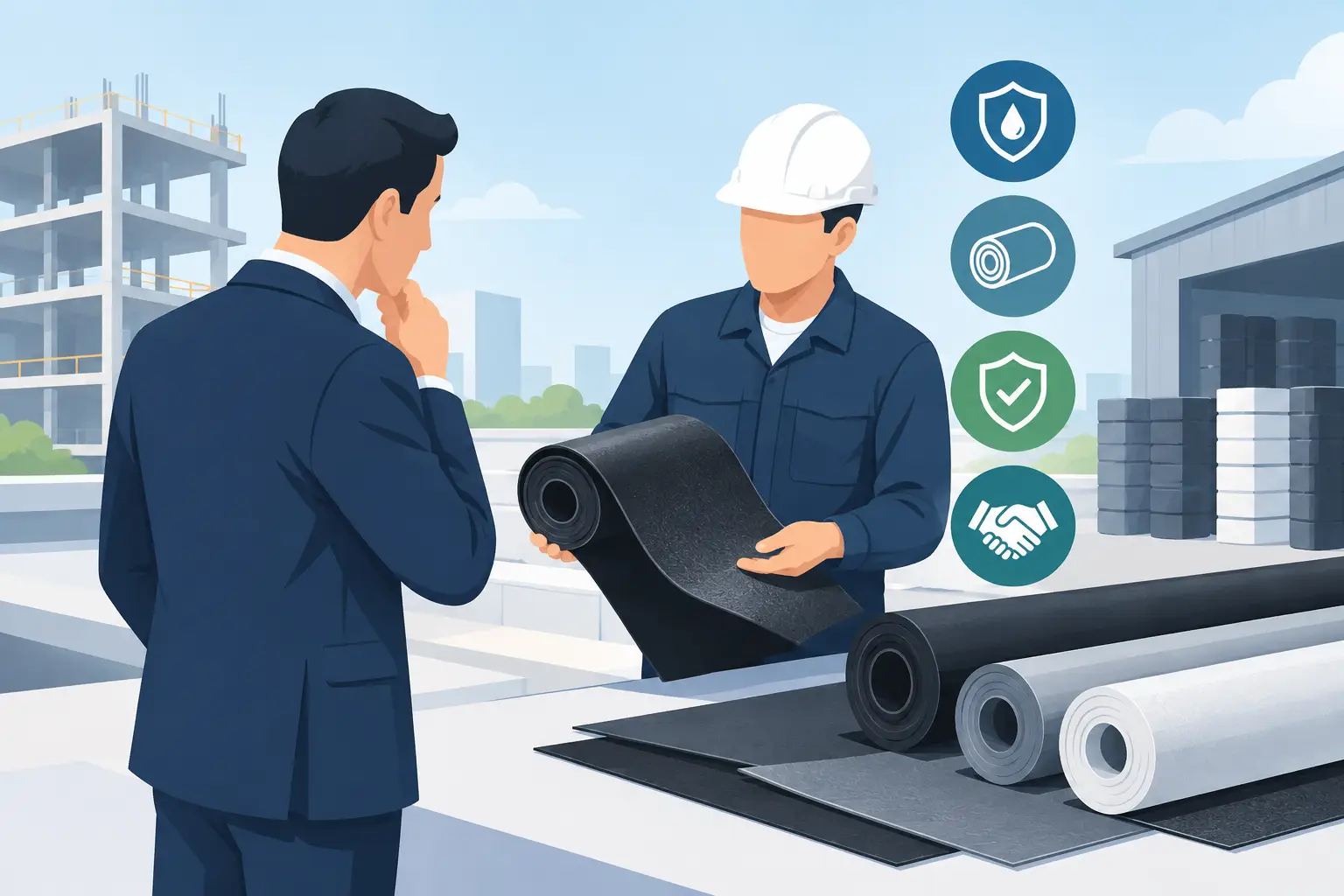
How to Choose a Waterproofing Membrane Supplier
A waterproofing membrane is rarely the most visible part of a building, but failure can quickly become the most expensive problem on site. Water intrusion damages concrete, insulation, finishes, electrical systems, and equipment while creating delays that affect every trade. Choosing a waterproofing membrane supplier is therefore not simply a purchasing decision. It is a decision about material performance, installation confidence, and long-term project protection.
For contractors, procurement teams, and project managers, the right supplier provides more than rolls, sheets, or liquid-applied products. They provide consistent quality, suitable technical guidance, dependable availability, and a product range that fits real site conditions. The lowest unit price may look attractive at tender stage, but it does not account for rework, labor disruption, warranty exposure, or premature maintenance.
Start With the Application, Not the Product Name
“Waterproofing membrane” covers a broad category. A membrane that performs well below grade may not be appropriate for an exposed roof. A product selected for a clean concrete substrate may not tolerate a repair project with irregular surfaces, penetrations, or difficult access.
Before comparing suppliers, define where the system will be used and what it must resist. Below-grade foundations and retaining walls face hydrostatic pressure and persistent soil moisture. Roofs face heat, UV exposure, standing water, wind movement, and thermal cycling. Bathrooms, kitchens, balconies, and wet rooms demand careful treatment around drains, corners, and pipe penetrations. Water tanks, podium decks, tunnels, and industrial floors can introduce further requirements for chemical contact, traffic loads, or structural movement.
A capable supplier should ask practical questions before recommending a solution. What is the substrate? Is it new construction or repair work? Will the membrane be exposed or protected by screed, insulation, soil, tiles, or another finish? What temperatures will it experience? Are there movement joints, cracks, or high-risk penetrations? These questions identify the correct system instead of forcing a standard product into the wrong application.
What a Waterproofing Membrane Supplier Must Prove
Product brochures can make similar claims, but professional buyers need evidence that materials will perform consistently. Evaluate a waterproofing membrane supplier on the quality of its product data, manufacturing discipline, and ability to support the complete system.
Material Performance Under Site Conditions
The membrane must be suited to the project environment. Depending on the system, relevant performance factors include tensile strength, elongation, tear resistance, puncture resistance, adhesion, water-vapor behavior, UV stability, crack-bridging capacity, and resistance to heat or chemicals. No single property determines suitability. High flexibility can be valuable on moving substrates, while high puncture resistance may matter more for a below-grade wall that will be backfilled.
Ask for clear technical documentation that explains intended uses, substrate preparation, coverage or thickness requirements, curing conditions, and limitations. Product data should be specific enough for engineers, applicators, and quality teams to work from the same standard.
Batch Consistency and Traceability
Waterproofing is a system where inconsistency creates hidden risk. Differences in coating viscosity, sheet thickness, reinforcement quality, or adhesive behavior can complicate installation and compromise performance. For commercial projects, buyers should confirm that the supplier controls batch quality and can identify delivered materials by production reference.
Traceability matters when a project spans several phases or multiple locations. If the same membrane is required months later for extensions, repairs, or maintenance, the procurement team needs confidence that the material will remain consistent and available.
Compatibility With Adjacent Materials
A membrane does not work alone. It interfaces with primers, sealants, adhesives, protection boards, insulation, drainage layers, tiles, screeds, coatings, and joint-treatment products. Incompatible materials can soften a membrane, weaken adhesion, create staining, or leave vulnerable transitions around penetrations.
The best suppliers take a system view. They can identify compatible accessories and explain how details should be handled at internal corners, external corners, drains, parapets, joints, upstands, and service penetrations. This is particularly valuable for MEP-heavy projects, where every pipe, duct support, and cable route can become a potential leak path.
Supply Reliability Is Part of Waterproofing Performance
A technically correct membrane cannot protect a project if it is unavailable when the crew is ready to install it. Delayed materials leave substrates exposed, interrupt sequencing, and may force contractors to use unsuitable substitutes. For time-sensitive construction and maintenance work, supply reliability is a performance requirement.
Assess whether the supplier can maintain stock of the main membrane, compatible primers, detailing products, and repair materials. A supplier that carries only the headline product may create avoidable delays when accessories are needed. Broad SKU availability also gives procurement teams more flexibility when project conditions change.
Delivery consistency deserves the same attention. Confirm lead times, packaging formats, minimum order quantities, storage requirements, and the supplier’s ability to support phased deliveries. Materials that arrive damaged, poorly stored, or without proper identification can be as disruptive as materials that arrive late.
For distributors and commercial buyers, dependable supply also protects customer relationships. A waterproofing range should support repeat orders with consistent product naming, packaging, and technical positioning. That makes it easier for sales teams and contractors to specify, stock, and apply the right solution every time.
Evaluate Technical Support Before the Job Starts
Many waterproofing failures begin before application. The substrate may be damp, contaminated, weak, uneven, or improperly repaired. The membrane may be applied at the wrong thickness, installed outside its temperature range, or terminated incorrectly at a wall or drain. These are execution issues, but the supplier’s guidance can reduce them.
Look for a supplier that can support product selection with direct, practical information. The strongest support is not vague reassurance. It includes clear application instructions, substrate preparation requirements, coverage calculations, curing times, storage guidance, and detail recommendations.
Technical support should also recognize trade-offs. Liquid-applied membranes can be effective on complex geometries and difficult details, but they depend on disciplined thickness control and curing conditions. Sheet membranes can deliver uniform factory-controlled thickness, but seams, laps, and termination details require accurate workmanship. Cementitious systems can be practical in wet areas and concrete structures, while elastomeric systems may offer stronger crack-bridging performance. The right choice depends on the substrate, exposure, access, project schedule, and protection layer.
Compare Total Project Value, Not Only Price
A low-cost membrane can become an expensive decision if it requires excessive preparation, creates application uncertainty, or fails prematurely. Procurement teams should compare the full installed value of each option: material cost, primer and accessory requirements, labor time, expected waste, protection needs, delivery reliability, and the cost of remedial work if something goes wrong.
This approach is especially important in high-consequence areas. A leak beneath tile finishes, below a landscaped podium, or inside an operating facility can cost many times more to repair than the original membrane installation. Better material selection and reliable detailing are often among the most cost-effective forms of risk control available to a project.
The Engineer range reflects this performance-led approach by connecting waterproofing materials with related sealants, adhesives, coatings, and repair solutions used across demanding construction and maintenance environments. For buyers, a consolidated industrial portfolio can simplify sourcing while helping ensure that connected materials are selected with compatibility and dependable site performance in mind.
Questions to Ask Before Appointing a Supplier
Before placing an order, procurement teams should be able to get direct answers to the following questions:
- Which membrane system is recommended for this exact substrate, exposure level, and finish?
- What preparation, primer, thickness, overlap, curing, or protection requirements apply?
- Which accessories are required for corners, joints, drains, penetrations, and terminations?
- What technical data and batch identification will be supplied with the materials?
- Can the supplier maintain availability for phased work, repairs, and future maintenance?
- What storage conditions and shelf-life controls are needed on site?
Direct answers indicate that the supplier understands the application. General claims without product-specific guidance should be treated carefully, particularly where water pressure, movement, weather exposure, or difficult detailing are involved.
Build Confidence Before Water Tests It
The right membrane is the one that matches the application, can be installed correctly, and remains available when the project needs it. Select a supplier that treats waterproofing as a complete protection system rather than a commodity roll or coating. That decision gives installers clearer direction, procurement teams greater control, and building owners a stronger defense against the cost of water intrusion.

Leave a Reply