

Concrete Waterproofing Project Results That Last
A basement wall may look sound at handover, yet fail after the first wet season because moisture found one untreated joint, pinhole, or termination detail. Concrete waterproofing project results are determined long before water reaches the structure. They depend on selecting the right system, preparing the substrate correctly, and controlling application conditions from the first repair through final inspection.
For contractors, project managers, and procurement teams, waterproofing is not a finishing item. It is a risk-control system for foundations, roofs, water-retaining structures, parking decks, wet rooms, and exposed concrete. A material that performs well in one location can fail in another if hydrostatic pressure, crack movement, UV exposure, or substrate moisture were not properly evaluated.
What Strong Concrete Waterproofing Project Results Look Like
The most valuable result is not simply a dry surface on the day of inspection. It is a concrete structure that continues to resist water ingress through seasonal movement, temperature changes, cleaning cycles, traffic vibration, and normal aging.
On below-grade work, reliable performance means water is stopped before it reaches occupied spaces, electrical systems, finishes, or stored materials. On roofs and podium decks, it means the coating or membrane remains continuous at drains, upstands, penetrations, and expansion joints. In water tanks, pits, and utility structures, it means the system withstands sustained contact with water without blistering, debonding, or contaminating the service environment.
Good project outcomes are measurable. They reduce callbacks, protect structural reinforcement from corrosion, limit mold and finish damage, and lower the maintenance burden over the asset life. They also create a clearer handover record: the specified system, coverage rates, repairs, inspection points, and curing conditions should all be documented.
Start With the Water Exposure, Not the Product
Concrete is durable, but it is not automatically watertight. Its capillaries, shrinkage cracks, construction joints, tie-rod holes, honeycombing, and service penetrations can all become water paths. The correct solution begins with identifying how water will act on the concrete.
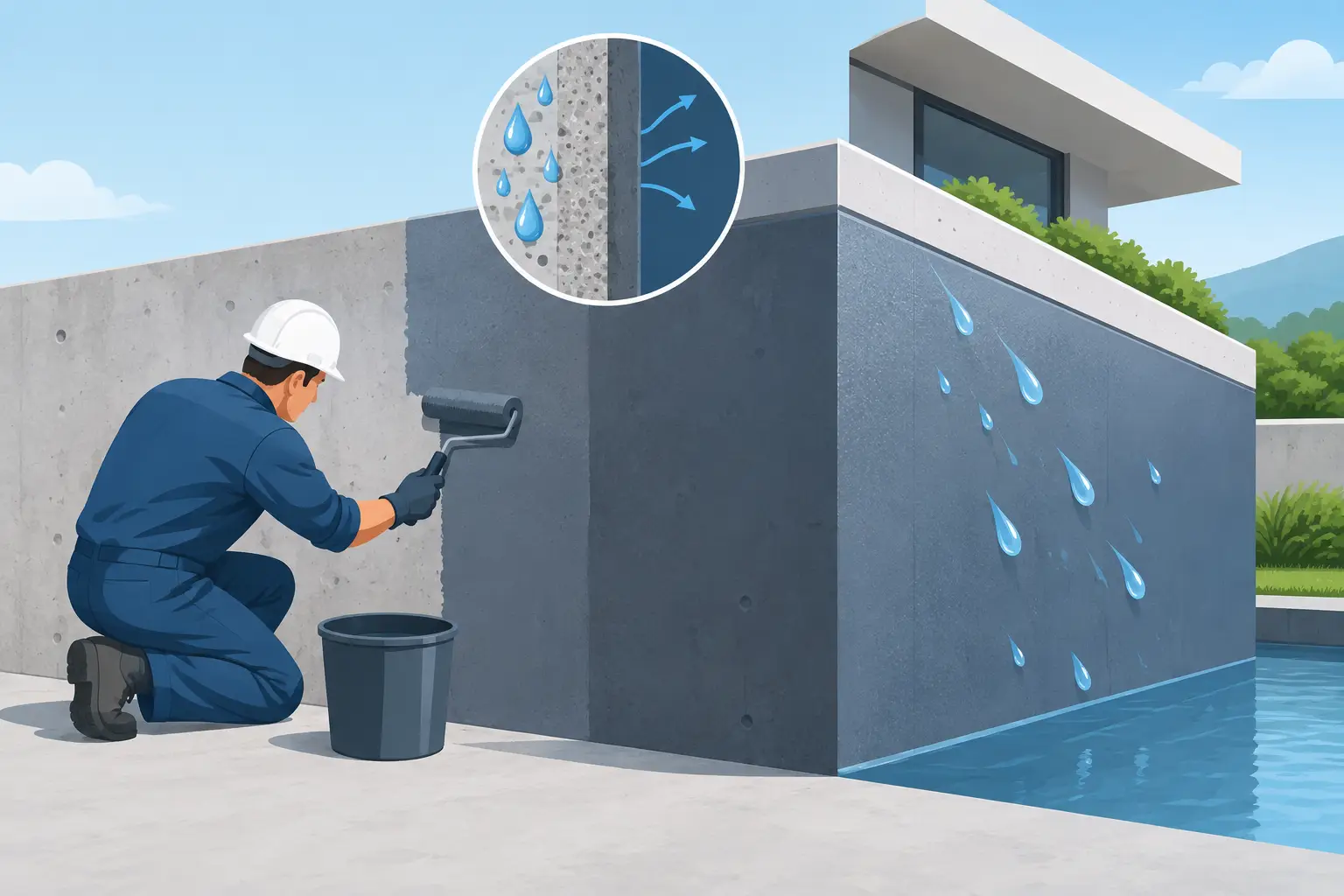
Positive-side waterproofing is applied to the face exposed to water, such as the exterior of a foundation wall or the top surface of a roof slab. It is generally the preferred approach because it prevents water from entering the concrete matrix. Negative-side waterproofing is applied on the interior face, where access to the water-exposed side is impossible. It can be effective, particularly with cementitious systems designed for damp substrates and hydrostatic pressure, but the concrete itself remains exposed to moisture.
The design team should also determine whether the issue is occasional rain, groundwater pressure, standing water, washdown, or chemical-bearing water. A coating suitable for wind-driven rain may not be suitable for permanent immersion. A flexible membrane may bridge moving cracks better than a rigid treatment, while a cementitious system may be more practical on damp, irregular concrete. There is no universal waterproofing product because the water condition and structure dictate the system.
Surface Preparation Decides the Bond
Most premature waterproofing failures are not caused by the label on the pail. They are caused by weak surface preparation, poor detailing, or application outside the recommended conditions.
The concrete must be sound, clean, and free from contaminants that interfere with adhesion. Dust, laitance, curing compounds, oils, loose coatings, and weak repair mortar must be removed. Mechanical preparation is often required to create a stable, open-textured surface. Smooth concrete may need abrasion, while heavily damaged areas may need localized breakout and repair before coating begins.
Moisture condition matters as well. Some systems require a dry substrate. Others are formulated to tolerate damp concrete, but they still cannot compensate for active leaks, standing water, or uncontrolled moisture vapor. Teams should verify the product requirement rather than assume that a waterproofing material can be applied to any wet surface.
Cracks and joints need separate attention. Nonmoving cracks may be repaired with an appropriate rigid repair material or injection method. Moving joints require flexible joint treatment designed to accommodate movement. Simply coating over an open expansion joint often produces a predictable crack line and a future leak.
Details Are Where Waterproofing Systems Win or Fail
Large flat areas are straightforward. Corners, drains, pipe penetrations, wall-to-slab connections, terminations, and changes in material are not. These transition points concentrate movement and are common locations for coating discontinuity.
A disciplined installation sequence usually includes repairing defects, forming fillets where required, treating joints and penetrations, reinforcing vulnerable transitions, applying the main waterproofing layer at the specified rate, and protecting the completed system from damage. The exact steps vary by material, but the principle remains the same: continuity is essential.
Coverage rate deserves close control. Applying too little material can leave the dry film thickness below the required level, even when the surface appears coated. Applying excessive thickness in one pass can cause slow curing, cracking, sagging, or trapped solvent depending on the system. Wet-film checks, batch tracking, and defined application passes give the project team evidence that the installed system matches the design intent.
Protection is equally important. A properly applied foundation membrane can be punctured during backfilling. A roof coating can be damaged by follow-on trades. Where the service environment requires it, protection boards, drainage layers, screeds, or compatible topcoats should be included as part of the waterproofing scope, not treated as optional extras.
Match Material Performance to the Job Site
Cementitious waterproofing systems are widely used for concrete water tanks, basements, bathrooms, and masonry surfaces. They can be practical for irregular substrates and, depending on formulation, may be applied to damp concrete. Their limitation is movement. If the substrate is expected to crack or flex significantly, a rigid cementitious layer alone may not maintain continuity.
Flexible liquid-applied coatings can create a continuous barrier around complex shapes and penetrations. They are often valuable for roofs, balconies, wet areas, and exposed concrete where crack-bridging capability is required. Their performance depends on correct thickness, curing, and protection from unsuitable traffic or UV exposure.
Sheet membranes offer controlled factory thickness and can perform well on large, accessible areas. However, laps, seams, terminations, and puncture resistance demand careful workmanship. Sealants and compatible tapes also have a critical role at joints, flashings, and penetrations, but they should support the system design rather than substitute for a complete waterproofing assembly.
For demanding construction and maintenance work, The Engineer range supports professional teams with performance-led waterproofing and sealing materials designed for reliable application conditions. The right material still requires the right substrate, detail, and installation method.
Quality Control Turns Application Into Results
Waterproofing should be inspected in stages, not only after the last coat has dried. Early inspection prevents small defects from becoming concealed failures behind cladding, soil, screeds, or finishes.
Before application, confirm substrate readiness, repair completion, surface profile, moisture condition, and weather suitability. During application, verify mixing ratios where applicable, pot life, ambient temperature, coverage rate, coat intervals, and treatment of all details. After curing, inspect for pinholes, thin spots, blisters, incomplete laps, damaged areas, and unsealed transitions.
Testing should suit the structure. Flood testing can be appropriate for horizontal waterproofed areas when the assembly and drainage design allow it. Electronic leak detection may be valuable on specific membrane systems. For below-grade work, visual inspection and documented protection before backfill are often essential because post-installation access is limited. Testing cannot repair a poor installation, but it can identify defects while corrective work is still economical.
The Cost of Choosing the Cheapest System
Waterproofing procurement is often pressured by initial price, especially when the material is a small percentage of the total project value. That comparison can be misleading. The cost of reopening finishes, excavating around foundations, replacing insulation, repairing corrosion, and managing tenant disruption can exceed the original waterproofing package many times over.
The most economical choice is usually the system with the correct technical fit, proven application process, compatible components, and dependable supply. This does not always mean selecting the highest-priced option. It means evaluating lifecycle risk rather than comparing unit prices alone.
A contractor also needs material availability that matches the construction sequence. Delayed deliveries can force rushed substitutions or leave prepared surfaces exposed beyond their intended window. Consistent product quality and practical technical guidance help teams maintain the same installation standard across multiple work areas and projects.
Waterproofing earns its value quietly. When the system is properly specified, applied, inspected, and protected, the building stays dry, operations continue, and the project team avoids the expensive work no one planned to do twice.

Leave a Reply