

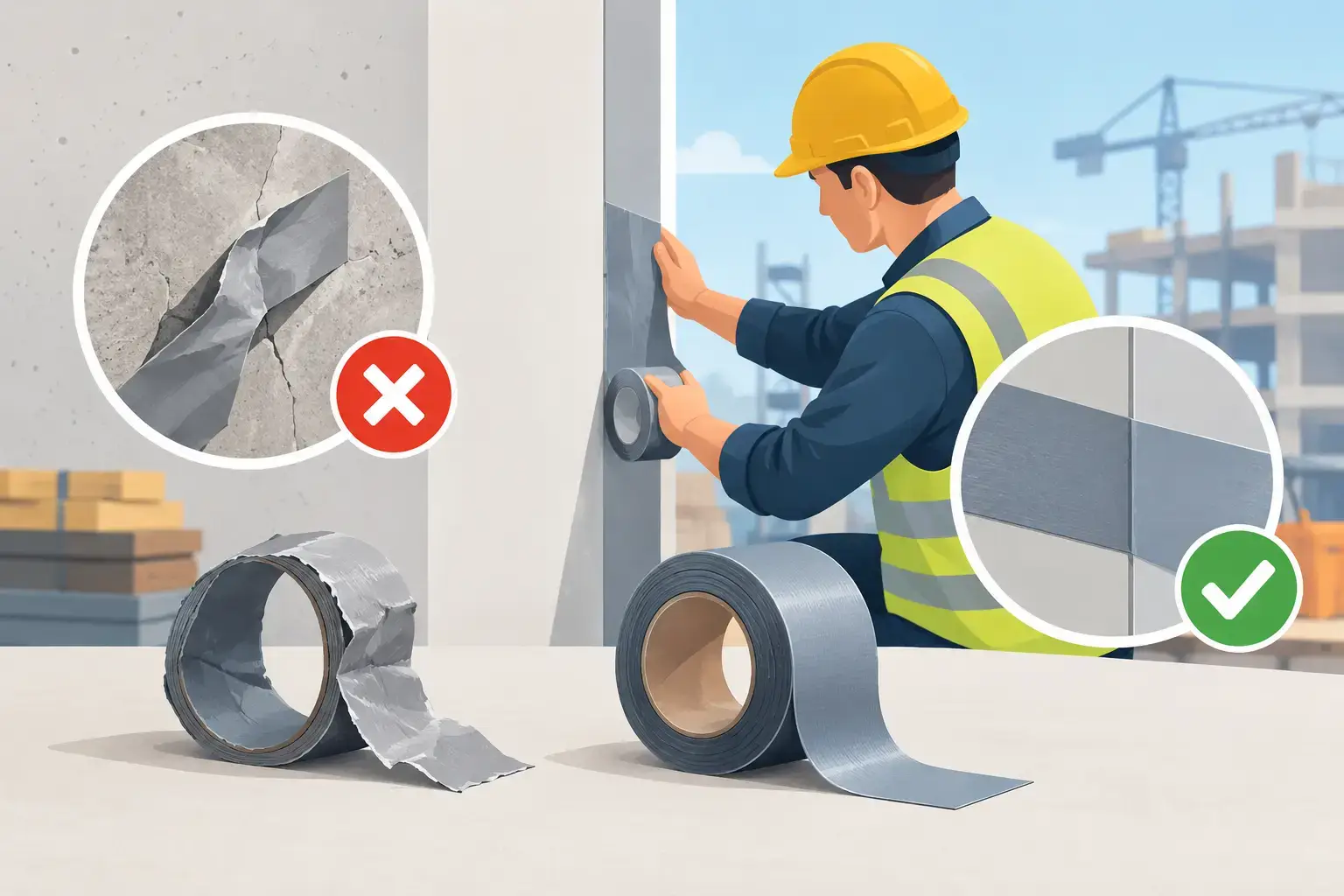
Why Tapes Fail on Job Sites and How to Prevent It
A tape joint that releases after handover is rarely just a tape problem. It can lead to air leaks in ductwork, failed protective masking, loose trim, moisture intrusion, production delays, and costly return visits. Understanding why tapes fail gives contractors, maintenance teams, and procurement professionals a practical way to prevent those outcomes before a roll reaches the work area.
Industrial tape performance depends on a complete system: the substrate, adhesive chemistry, backing material, site conditions, application method, and service environment. A strong tape used in the wrong conditions can fail. The right tape applied to a poorly prepared surface can fail just as quickly.
Why Tapes Fail in Professional Applications
The visible failure may be lifting edges, adhesive residue, cracking, tearing, or a clean release from one surface. Each pattern provides a clue. Teams that identify the failure mechanism can correct the process rather than repeatedly replacing material without addressing the cause.
The Surface Was Never Ready for Bonding
Dust, oil, moisture, oxidation, release agents, and powder-coated residue create a barrier between the adhesive and the substrate. The tape may appear secure during installation, then release once vibration, heat, or load exposes the weak interface.
This is common in automotive repair bays, HVAC installations, fabrication areas, and construction sites where surfaces are handled frequently or exposed to airborne dust. Even a clean-looking panel can carry silicone, wax, cutting fluid, or fingerprints that reduce adhesive contact.
Surface preparation should match the substrate and the application. Remove loose material first, then clean with a compatible method that does not leave a residue. Allow the surface to dry fully before application. On porous materials such as concrete, untreated wood, or gypsum-based surfaces, a tape may require a primer, a different adhesive system, or an alternative fastening approach.
The Tape Does Not Match the Substrate
Not all surfaces accept adhesives in the same way. High-surface-energy materials such as steel, aluminum, glass, and many painted surfaces generally bond well when clean. Low-surface-energy plastics, including polyethylene and polypropylene, are far more difficult. Some powder coatings, textured finishes, rubber compounds, and plasticized materials also need specialized adhesive formulations.
A general-purpose tape may provide acceptable initial tack on a difficult surface but lose adhesion over time. For example, a tape selected for smooth painted metal may not maintain a reliable bond on a rough insulation facing or a low-energy plastic component.
Specification should consider both sides of the joint. When bonding two dissimilar materials, the tape must be compatible with each surface and with the movement, temperature range, and exposure expected in service. This is where product selection should be based on performance requirements, not roll appearance or unit price alone.
Application Temperature Was Outside the Working Range
Pressure-sensitive adhesives need enough flow to wet out the surface. In cold conditions, the adhesive can become firm and resist that flow, reducing initial adhesion. In excessive heat, the adhesive may soften, creep under load, or become more vulnerable to contamination during installation.
Job-site temperature matters during application, not only after the work is complete. A tape installed on cold metal early in the morning may need more time, pressure, or a suitable cold-weather adhesive system to form a dependable bond. Conversely, exterior work in direct sun can expose a joint to temperatures far higher than ambient air temperature.
Always separate application temperature from service temperature. A tape may tolerate high heat once bonded but still require moderate temperatures during installation to establish its designed bond strength.
Insufficient Pressure Limited Adhesive Contact
Tape does not bond simply because it touches the surface. Pressure activates contact by pushing the adhesive into the microscopic peaks and valleys of the substrate. Hand pressure may be sufficient for a small repair, but wide tapes, long seams, textured surfaces, and critical joints often require a roller or firm, uniform pressure.
Insufficient pressure commonly produces edge lifting and partial adhesion. The center may seem secure while the edges remain vulnerable to dirt, moisture, and peel forces. On duct seams, protective films, mounting applications, and packaging operations, inconsistent pressure can create inconsistent results from one operator or shift to the next.
A disciplined installation procedure should define how much pressure is required, what tool is used, and whether the joint needs a dwell period before loading. This simple control can reduce rework significantly.
Tape Failure Often Begins With the Wrong Design Assumption
Many tape failures occur because a product intended for one force or exposure is used in another. Adhesives handle shear, peel, tensile load, impact, vibration, and environmental stress differently. A tape that holds well under a static overlap may fail quickly when a force pulls directly at its edge.
Peel Forces Were Underestimated
Peel is one of the most demanding forces for a tape bond. It concentrates stress along a narrow leading edge, encouraging the adhesive to lift progressively from the surface. A joint that is strong in shear can still fail in peel.
Where possible, design the application so the tape carries load across its bonded area rather than from an exposed edge. Increase bond area, avoid sharp pull angles, support flexible materials, and use mechanical retention where the load is continuous or safety-critical. Tape is an engineered solution, but it is not a substitute for structural fastening in every application.
The Backing Material Was Not Suitable
The backing controls more than appearance. It influences conformability, tear resistance, elongation, UV stability, chemical resistance, and the tape’s ability to maintain a seal around corners or irregular profiles.
A highly conformable backing is useful on curved surfaces, cable wrapping, and uneven assemblies, but it may stretch under load. A rigid backing can provide clean lines and dimensional stability, but it may bridge over surface texture or lift around tight radii. Foil, cloth, film, foam, and reinforced backings each serve different operating demands.
For MEP and HVAC work, the backing must also support the required resistance to humidity, aging, and temperature cycling. For automotive and maintenance work, abrasion, fluids, vibration, and exterior weathering can be equally important.
Environmental Exposure Was Ignored
A tape may perform well in a controlled workshop and fail outdoors or inside a demanding industrial system. Ultraviolet exposure can degrade certain backings and adhesives. Humidity can affect porous substrates and edge adhesion. Chemicals, fuel, oils, cleaning agents, and plasticizer migration can soften or weaken the adhesive layer.
Thermal cycling adds another challenge. Materials expand and contract at different rates, placing repeated stress on the bond line. Metal panels, plastic trim, glass, insulation facings, and coated surfaces do not move the same way. A tape selected for exterior or high-temperature service needs sufficient flexibility and durability to accommodate that movement over time.
Storage Conditions Can Compromise Tape Before Use
Tape is a manufactured performance product, not an indefinite warehouse commodity. Excessive heat, freezing temperatures, humidity, direct sunlight, dust, and poor stock rotation can alter handling and bond performance. Rolls stored in an open, dirty work area may collect contamination on exposed edges or become damaged before installation.
Store tape in a clean, dry area at the recommended temperature range, preferably in its original packaging. Use first-in, first-out inventory control and avoid holding stock beyond its recommended shelf life. For distributors and procurement teams, this is a supply discipline as much as a quality discipline: consistent storage and traceable inventory protect the performance expected by end users.
A Practical Process to Prevent Tape Failures
Reliable results come from standardizing a few decisions before work begins. Confirm the substrate type and condition, including any coating, texture, or contamination risk. Define the operating environment: temperature, moisture, UV exposure, chemical contact, vibration, and expected load. Then select the adhesive and backing combination for that exact duty.
Before full installation, run a representative trial on the actual materials. Test after the required dwell time and, where practical, after exposure to expected heat, cold, or moisture. A quick field trial is particularly valuable when the surface varies by supplier, batch, or age.
During application, clean and dry the substrate, apply at a suitable temperature, avoid touching the adhesive, and use consistent pressure across the complete bond area. Do not load the joint immediately unless the tape is designed for immediate service. Some applications benefit from time for the adhesive to build bond strength.
For critical work, document the tape specification, lot information, substrate, preparation method, and application conditions. This creates accountability and makes troubleshooting faster if a failure occurs later. The Engineer range is designed around this performance-first approach: matching dependable industrial tape solutions to the conditions professionals face on site.
A tape joint should not be judged by how firmly it feels in the first minute. The real measure is whether it remains sealed, secure, and functional after heat, vibration, moisture, handling, and time have done their work.
Leave a Reply