

HVAC Sealing Materials Guide for Reliable Systems
A duct joint that looks closed can still lose conditioned air, admit moisture, and create callbacks months after turnover. This HVAC sealing materials guide helps contractors, maintenance teams, and procurement professionals match the material to the joint, substrate, movement, and operating environment. The goal is not to use the most sealant everywhere. It is to create a durable air and moisture barrier that holds under pressure, vibration, temperature cycling, and routine service.
What HVAC Sealing Materials Must Do
HVAC systems use different sealing materials because they face different failure mechanisms. A supply-air duct seam needs long-term air leakage control. A rooftop penetration needs weather resistance and UV stability. A condensate connection needs reliable moisture containment. Equipment access panels need a compressible seal that can be opened and closed without tearing.
The right material must bond or compress correctly, remain stable at the expected temperature, tolerate movement where movement exists, and resist the contaminants present at the site. Dust, oil, standing water, cleaning chemicals, salt air, and ultraviolet exposure can each change the selection.
Material cost is only one part of the decision. A lower-cost tape that lifts at corners or a rigid sealant used on a moving joint can create expensive rework, air-balance problems, corrosion, insulation damage, and occupant complaints. Professional specification starts with the joint function, then confirms product compatibility and installation conditions.
The Main HVAC Sealing Material Categories
Duct sealants and mastics
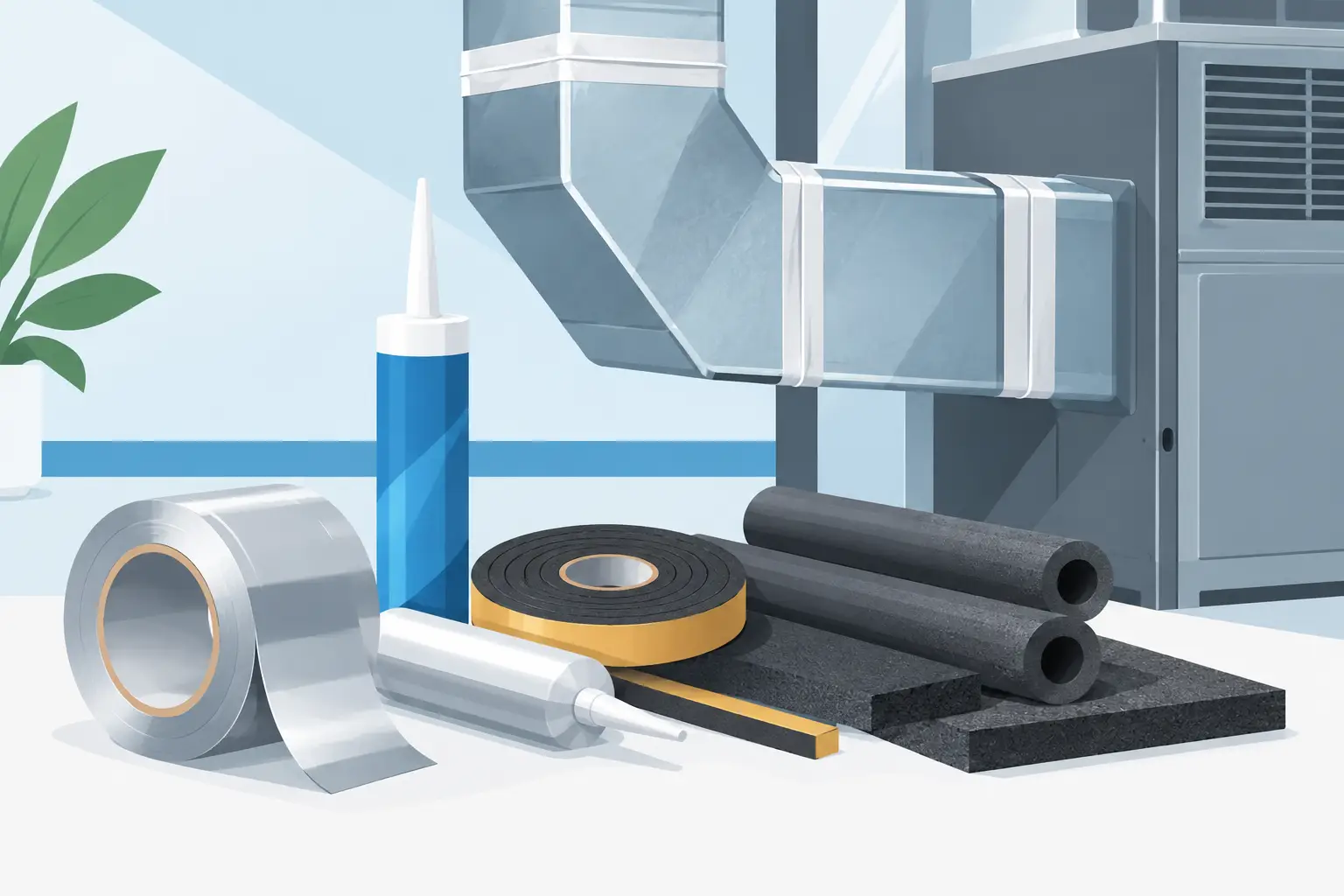
Duct sealants, often called mastics, are applied as a paste or heavy-bodied coating over duct seams, slip joints, collars, and connection details. They are designed to form a continuous flexible film after curing. For exposed or concealed sheet-metal ductwork, a quality duct sealant is often the primary air-sealing material because it conforms to irregular surfaces better than tape alone.
Mastic performs particularly well on joints with small gaps, screw heads, corners, and transitions. Reinforcing fabric may be used where a wider gap, weak joint geometry, or added mechanical strength calls for it. Application thickness matters. A film spread too thin may not bridge the seam effectively, while excessive material wastes product and slows curing.
Confirm whether the duct sealant is intended for indoor use, exterior exposure, or insulated duct systems. Some formulations are better suited to dry indoor mechanical rooms, while others are engineered for weather, humidity, and wider temperature ranges.
HVAC tapes
Foil tape, butyl tape, acrylic tape, and cloth-backed tapes all have roles in HVAC work, but they are not interchangeable. Aluminum foil tape is commonly used to seal foil-faced insulation, vapor barriers, and selected duct or equipment details. Its performance depends heavily on adhesive quality, surface preparation, and the temperature range of the installation.
Butyl tape provides high tack and strong moisture resistance. It is useful where surfaces are uneven, where a gasket-like tape is needed behind flanges, or where the assembly requires immediate adhesion before final fastening. Acrylic adhesive tapes can offer strong aging and temperature performance, particularly on clean, compatible substrates.
Tape is fast, clean, and practical for production work, but it is sensitive to installation discipline. Pressing tape onto dusty galvanized steel, wet insulation facing, or oily equipment panels is a common route to edge lift. Use tape where its adhesive system and backing suit the assembly. Do not treat every shiny foil tape as a permanent duct-seam solution.
Gaskets and closed-cell foam seals
Gaskets seal by compression rather than curing. They are used on access doors, air-handler panels, filter racks, equipment flanges, and connections that must remain serviceable. Closed-cell foam gaskets are widely used because they resist moisture absorption and recover after compression when correctly specified.
The critical question is compression set. A gasket that remains permanently flattened after service access may no longer maintain contact pressure. Consider gasket thickness, density, width, adhesion, and the clamping force available from latches, screws, or flange hardware. A thick soft gasket may seal an uneven panel well, but it can be damaged if the door is over-tightened. A denser gasket may last longer but may not seal a warped surface without sufficient fastening pressure.
Silicone, polyurethane, and hybrid sealants
General-purpose joint sealants are essential around HVAC penetrations, curbs, piping, sleeves, and equipment interfaces. Silicone sealants are valued for weather resistance, flexibility, and performance across changing temperatures. They are often selected for exterior sheet metal, flashing details, and joints exposed to sun and rain.
Polyurethane and hybrid polymer sealants provide strong adhesion on many construction substrates and can be useful where toughness, movement capability, and paintability matter. The best choice depends on the substrate and exposure. Some materials bond well to coated metal but are not ideal for certain plastics. Others may stain porous surfaces or require primer for dependable adhesion.
These products should not be used as a substitute for proper mechanical design. A large unsupported opening, loose curb, or poorly fastened duct section cannot be corrected with more sealant.
How to Select the Right HVAC Sealing Material
A practical HVAC sealing materials guide begins with five questions:
- Is the joint sealing air, water, vapor, dust, or a combination of these?
- Is the assembly permanent, or must it be opened for inspection and maintenance?
- What are the substrates: galvanized steel, aluminum, insulation facing, concrete, coated metal, plastic, or rubber?
- Will the joint move because of vibration, expansion, panel flexing, or equipment operation?
- What temperature, moisture, UV exposure, chemical contact, and pressure conditions will the material face?
For a permanent metal duct seam indoors, a compatible duct mastic may be the most dependable choice. For a removable access panel, a pressure-sensitive gasket is usually more practical. For an exterior roof curb or wall penetration, select a weather-resistant joint sealant with proven adhesion to the relevant metal, flashing, or masonry surface.
Substrate preparation is not a secondary detail. Clean, dry, sound surfaces give sealants and tapes the conditions needed to perform. Remove loose coatings, oil, dust, condensation, and old failing adhesive. On heavily corroded metal, repair or replace the substrate before sealing. A high-performance material cannot create a permanent bond to a surface that is already separating.
Installation Details That Prevent Rework
Most sealing failures begin at edges, overlaps, corners, and transitions. These are the areas where installers should slow down. Apply enough material to create continuous coverage, tool wet sealant into the joint where required, and avoid voids at screw heads or folded seams.
For tape applications, use firm, even pressure across the full width. Do not stretch tape excessively, especially around corners, because tension can pull the edges back over time. Overlap sections in the direction that sheds moisture when the detail may see condensation or weather. If a tape manufacturer specifies a primer, roller, overlap dimension, or minimum application temperature, those instructions are part of the system, not optional extras.
Cure time also affects project sequencing. Sealants may skin quickly but need more time to develop full performance. Protect fresh material from washdown, heavy dust, vibration, or premature system operation when the product instructions require it. On occupied retrofit projects, factor odor, ventilation, and access restrictions into material selection.
Avoid These Common Specification Mistakes
One frequent mistake is choosing material by appearance rather than use case. Foil backing does not automatically mean a tape can handle every duct seam or exterior exposure. Another is using rigid materials on joints that move. Temperature swings and equipment vibration will eventually expose that mismatch.
Avoid mixing incompatible products without verification. A sealant may not adhere to an existing coating, a tape adhesive may react poorly with plasticized surfaces, and a cleaning solvent may leave residue that weakens the bond. When repair work involves unknown legacy materials, test adhesion on a small area before committing to the full scope.
Procurement teams should also look beyond the initial SKU. Consistent batch quality, practical cartridge or pail sizes, shelf life, storage requirements, and dependable replenishment affect field productivity. The Engineer product range is built around this operational need: reliable industrial consumables that support consistent work across construction, MEP, maintenance, and fabrication environments.
Build Sealing Into the System, Not the Punch List
The strongest HVAC sealing program is planned before installation begins. Define which joints receive mastic, tape, gasket, or weatherproof sealant; verify compatible substrates; and make surface preparation part of the work standard. Then inspect the details that are hardest to correct after insulation, ceilings, or equipment enclosures are in place.
When a sealing material is selected for the actual joint conditions rather than convenience, it does more than close a gap. It protects system efficiency, preserves equipment performance, and gives the project team fewer reasons to return to the site.



Leave a Reply