

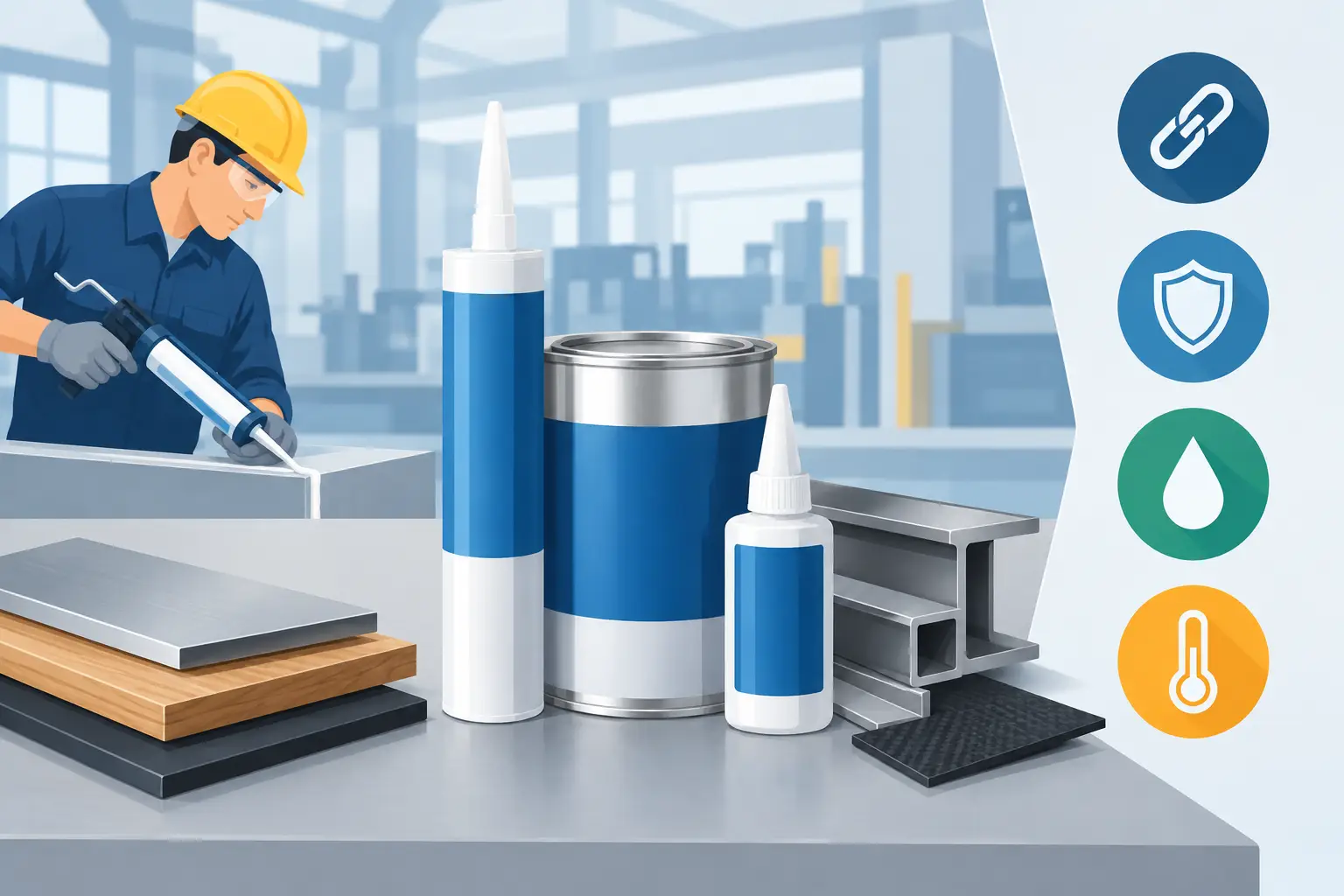
How to Choose Industrial Adhesive for Demanding Jobs
A bond that fails on a production line, rooftop unit, vehicle assembly, or repair job is rarely caused by one issue alone. The wrong adhesive may have been selected for the substrate, applied to an unprepared surface, or put into service before it reached full cure. Knowing how to choose industrial adhesive means evaluating the complete operating condition, not simply selecting the product with the highest stated strength.
For professional work, the best adhesive is the one that performs consistently across the actual materials, loads, temperatures, movement, and application conditions of the job. That decision protects quality, reduces rework, and helps keep maintenance schedules and project delivery on track.
Start With the Materials Being Bonded
Every adhesive selection begins with the substrates. Metals, plastics, glass, wood, concrete, ceramics, painted surfaces, rubber, and composites all have different surface energies, porosity, expansion rates, and chemical characteristics. An adhesive that bonds strongly to steel may not adhere reliably to polypropylene, polyethylene, or a powder-coated aluminum panel.
Identify both materials, including any coatings, films, primers, paint layers, galvanizing, oxidation, or contamination on the surface. In many applications, the adhesive is not bonding to the base material at all. It is bonding to the coating. If that coating fails, the bond fails with it.
Porous materials such as concrete, brick, untreated wood, and some stone may absorb part of the adhesive. They often require a formulation with suitable viscosity and wetting behavior to build a reliable mechanical grip. Smooth, non-porous surfaces require strong contact and may need cleaning, abrasion, or a compatible primer before bonding.
Dissimilar materials deserve special attention. Steel and aluminum, for example, expand at different rates when temperatures change. A rigid adhesive can be effective where the assembly remains stable, while a flexible adhesive or sealant may be the better choice when thermal movement or vibration is expected.
Define the Load Before Comparing Strength Claims
A high tensile-strength number alone does not determine whether an adhesive is suitable. Real assemblies experience loads in different directions, and each one places stress on the bond line differently.
Shear load occurs when two bonded surfaces slide parallel to each other. Peel load pulls one edge of a flexible material away from another surface. Tensile load pulls directly apart, while cleavage forces concentrate stress at one edge of a rigid joint. Most industrial adhesives perform best in shear and less effectively in peel or cleavage unless the joint and product are designed for those conditions.
Consider whether the joint must carry weight, resist repeated impacts, support a mounted component, or hold materials in position during assembly. In structural or safety-critical applications, the adhesive should be selected against documented design requirements, joint geometry, and validated test data. Do not rely on a general-purpose product where the consequences of failure are significant.
Joint design also affects performance. A broad overlap area usually distributes force better than a small butt joint. Maintaining the recommended bond-line thickness matters as well. Too little adhesive can leave gaps and limit stress distribution, while excessive thickness can reduce strength or delay cure.
Match the Adhesive to the Working Environment
Industrial bonds are exposed to more than load. Heat, cold, moisture, UV exposure, chemicals, vibration, dust, and washdown cycles can each change adhesive performance over time. The application environment should be treated as a primary specification.
For outdoor construction and maintenance work, select products with proven weather resistance and UV stability. A product that performs well in a controlled workshop may become brittle, discolor, or lose adhesion after continuous sun and rain exposure. For MEP and HVAC installations, also consider condensation, temperature cycling, and vibration from operating equipment.
Automotive, industrial manufacturing, and facilities maintenance applications may introduce oils, fuels, lubricants, cleaners, coolants, or process chemicals. Chemical resistance must be evaluated against the actual substances involved, their concentration, temperature, and exposure duration. Brief splashes and continuous immersion are not the same condition.
Temperature affects both application and long-term service. Some adhesives cannot cure properly in low temperatures or high humidity. Others are designed to maintain flexibility through thermal cycling. Where equipment operates near ovens, engines, exhaust systems, hot piping, or refrigeration units, confirm the product’s service-temperature range instead of assuming a standard adhesive will be sufficient.
Choose the Right Adhesive Chemistry
The adhesive family should fit the material combination and performance requirement. The following categories are widely used across professional applications:
- Epoxy adhesives provide high strength, strong adhesion to many metals and rigid materials, and good resistance to chemicals. They are often selected for durable assembly, repair, and structural bonding, though some formulas can be relatively rigid.
- Polyurethane adhesives combine strong bonding with flexibility. They are useful where movement, vibration, and dissimilar-material bonding are part of the application.
- Silicone adhesives and sealants remain flexible and typically perform well in high-temperature, weather-exposed, and moisture-prone locations. They are commonly used where sealing and bonding must work together.
- Acrylic adhesives can deliver strong bonding with fast fixture times, including on many metals and plastics. They are often considered where production speed is critical.
- Cyanoacrylates provide fast bonding for small, close-fitting parts, but they are not automatically the best choice for large gaps, flexible joints, or constant outdoor exposure.
- Construction and hybrid polymer adhesives are practical for many building, installation, and maintenance jobs, particularly when broad substrate compatibility and weather resistance are required.
No chemistry is best in every case. A fast-setting adhesive may increase throughput but leave little time for alignment. A flexible product may handle movement well but not meet a high structural-load requirement. The correct choice balances strength, movement capability, cure profile, and durability in service.
Consider Cure Time, Open Time, and Production Reality
An adhesive must work at the speed of the operation. Open time is the period available to position the parts after adhesive application. Fixture time is how long components must be held before they can be moved or processed. Full cure is when the adhesive reaches its intended final performance.
These three stages should be considered separately. A product may achieve handling strength quickly while requiring 24 hours or more for full cure. Putting a bonded assembly into service too early can create hidden weaknesses that appear later as leaks, separation, or fatigue failure.
For high-volume manufacturing, a fast fixture time can improve throughput and reduce clamping requirements. For field installation, a longer open time may be more valuable because technicians need time to position large panels, ducts, trims, or components accurately. Temperature and humidity can significantly change cure behavior, so published performance should be checked against actual site conditions.
Surface Preparation Is Part of Adhesive Selection
Even a premium industrial adhesive cannot compensate for oil, dust, weak paint, loose rust, or moisture beyond its application limits. Surface preparation should be specified as part of the job method, not treated as an optional finishing step.
Remove dirt, grease, release agents, and loose material with an appropriate cleaner. Dry the surface fully when the adhesive requires it. For difficult metals, coated panels, and low-energy plastics, light abrasion or a recommended primer can improve bond reliability. After preparation, avoid touching critical bonding areas with bare hands, as skin oils can affect adhesion.
Run a practical trial on representative materials whenever the application is new, high-value, or exposed to demanding conditions. The trial should use the intended surface preparation, adhesive bead size, assembly pressure, cure time, and service environment. A small validation test can prevent major losses in materials, labor, and site time.
Evaluate Packaging, Application Method, and Supply Consistency
The product must be practical for the people applying it. Cartridge, sausage pack, dual-component cartridge, pail, aerosol, and bulk formats each suit different work volumes and equipment. Confirm that the adhesive can be dispensed accurately with the tools available and that mixing ratios are controlled where two-part products are used.
For procurement teams and distributors, consistency matters beyond the first purchase. Standardized quality, clear technical documentation, dependable batch performance, and reliable SKU availability reduce disruption across multiple sites and recurring maintenance programs. A cheaper adhesive that creates rework, application variability, or stock delays can quickly become the more expensive option.
The Engineer range is built around this practical requirement: professional-grade industrial consumables that support demanding work with strength, durability, and dependable performance across construction, automotive, MEP/HVAC, manufacturing, and maintenance applications.
Before approving an adhesive for regular use, document the substrate, preparation process, joint design, application temperature, cure schedule, and acceptance criteria. That discipline turns adhesive selection from a product purchase into a controlled process. The right bond is the one that continues to perform long after the installer has left the job site.

Leave a Reply