

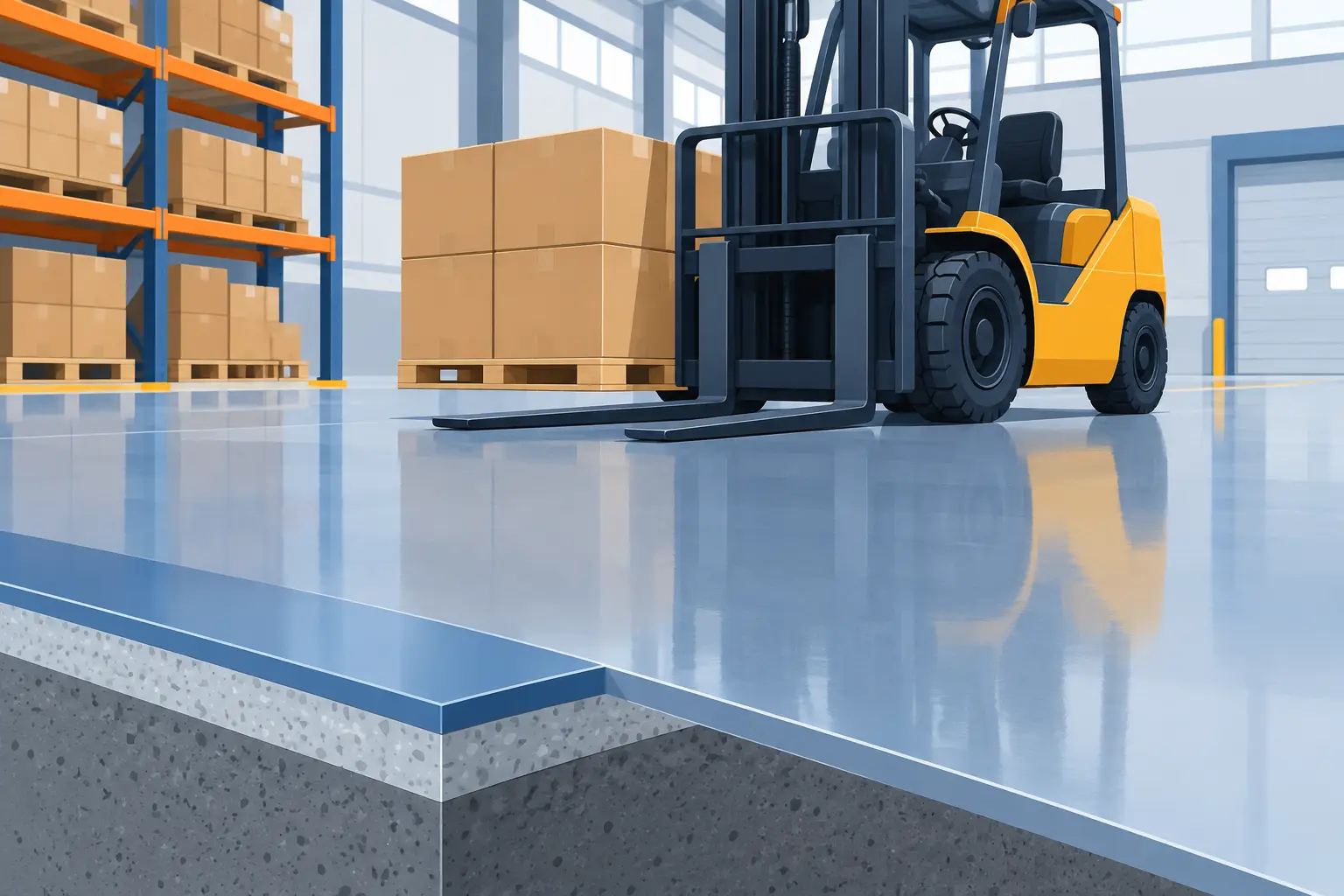
Industrial Floor Coating That Holds Up Under Load
A failed floor does more than look worn. It creates dust, absorbs oils and chemicals, complicates cleaning, and can force work areas out of service. The right industrial floor coating turns concrete into a durable working surface designed for traffic, spills, impact, and daily maintenance demands.
For contractors, maintenance teams, facility managers, and procurement professionals, coating selection should begin with the operating environment. A warehouse aisle, automotive service bay, food processing room, mechanical plant, and manufacturing line may all have concrete floors, but they do not place the same demands on the coating system.
What an Industrial Floor Coating Must Do
An industrial floor coating is a protective system applied over prepared concrete to improve resistance, service life, safety, and appearance. Its job is not simply to add color. It must bond securely to the substrate and remain stable under the conditions that matter on site.
In a busy facility, those conditions may include forklift movement, pallet loading, dropped tools, tire traffic, abrasion, oil exposure, washdown cycles, humidity, and temperature changes. Where coatings are selected only by price or appearance, premature peeling and repeated repairs are common. The lower initial cost can quickly become the more expensive decision when downtime, labor, and disrupted production are included.
A properly specified system creates a cleaner, more controlled work surface. It can reduce concrete dusting, make spills easier to identify and remove, and support marked traffic lanes, work zones, and safety areas. The result is a floor built to support operations rather than become another maintenance problem.
Start With the Concrete, Not the Topcoat
Coating performance depends heavily on the condition of the slab. Even a high-quality formulation cannot compensate for weak, contaminated, or moisture-affected concrete. Surface preparation is the point where many coating failures begin or are prevented.
Concrete must be sound, clean, and mechanically profiled so the coating can anchor into the surface. Oils, curing compounds, old paint, loose laitance, and dust interfere with adhesion. In automotive workshops and industrial maintenance areas, oil contamination can penetrate deeply into concrete and may require aggressive cleaning and mechanical preparation before coating work starts.
Moisture also requires careful evaluation. Moisture vapor moving through a slab can push against the bond line and cause blistering or delamination. This is particularly relevant for ground-level slabs, older facilities, areas with poor vapor barriers, and projects where concrete has not had sufficient time to dry. A moisture-tolerant primer may be appropriate in certain conditions, but it is not a substitute for proper assessment.
Mechanical grinding, shot blasting, or scarifying creates the profile needed for dependable adhesion. The best method depends on the substrate condition and the specified coating thickness. The goal is consistent preparation across the full area, including edges, repairs, joints, and high-traffic transition zones.
Match the Coating Chemistry to the Exposure
There is no single best coating for every industrial floor. The correct choice depends on the chemicals present, traffic type, required cure time, temperature range, cleaning regime, and expected service life.
Epoxy systems for hard-working interiors
Epoxy coatings are widely used in workshops, warehouses, factories, utility rooms, and production areas. They provide strong adhesion, good abrasion resistance, and dependable protection against many oils, fuels, and industrial chemicals. Epoxy systems can also build thickness, helping to level minor surface irregularities or create a more substantial protective layer.
Their limitation is UV exposure. Standard epoxies can yellow or chalk in direct sunlight, so they are generally better suited to interior areas or protected spaces. For a facility with large open doors or exterior-adjacent work zones, a UV-stable topcoat may be required.
Polyurethane topcoats for wear and color stability
Polyurethane coatings are valued for abrasion resistance, flexibility, and color retention. They are often used as a protective topcoat over epoxy systems where appearance and long-term wear matter. Their ability to handle movement and thermal change can be useful in facilities exposed to varying temperatures.
Polyurethane is not automatically the best answer for every project. Some systems require controlled application conditions, and chemical resistance varies by formulation. Procurement teams should confirm the specific exposure requirements rather than relying on a generic product description.
Fast-cure systems for limited shutdown windows
Some industrial facilities cannot close an area for several days while a conventional coating cures. Fast-cure materials can shorten return-to-service time and are useful for repair zones, loading areas, commercial workshops, and phased maintenance work.
The trade-off is that fast-curing products demand disciplined mixing, application timing, and crew coordination. Once mixed, working time may be limited. A capable application team and clear installation plan are essential to achieve an even finish and reliable bond.
Build the System Around Real Traffic
Floor traffic is more complex than a simple statement such as “heavy duty.” A floor that carries foot traffic and hand carts needs different protection from one that sees loaded forklifts, steel-wheeled equipment, frequent turning, or point loads from machinery.
Forklift turning areas are especially demanding. The lateral force created by turning tires can wear coatings faster than straight travel lanes. Loading docks, entrances, battery charging zones, and machine perimeters often deserve added thickness or a more resistant system. If the floor will receive impact from tools, metal parts, or equipment movement, aggregate-filled coatings or thicker resin systems may offer better protection than a thin paint-like finish.
Texture should also be specified with care. Anti-slip aggregates can improve safety in wet, oily, or washdown environments, but excessive texture can make cleaning harder and increase wear on wheels. The right profile provides traction without creating a surface that traps dirt and complicates routine maintenance.
Chemical Resistance Should Be Specific
“Chemical resistant” is not a complete specification. A coating may perform well against occasional oil contact but fail under regular exposure to strong solvents, acids, alkalis, brake fluid, cleaning agents, or hot tire plasticizers. Exposure concentration, temperature, dwell time, and cleaning frequency all affect performance.
Before selecting a system, identify the actual materials used on site. Automotive facilities may need resistance to oils, fuels, coolants, and cleaning products. Manufacturing plants may face process chemicals, lubricants, and washdown agents. MEP rooms may primarily require dust control and easy maintenance, while chemical storage areas can require a much more specialized lining system.
This level of detail protects both the project budget and the operating schedule. A coating that is technically suitable for one spill type may not be suitable for continuous immersion or repeated exposure. Product selection should be based on the most demanding credible condition, not the average day.
Application Discipline Determines Service Life
Material quality matters, but installation quality determines whether that material can perform as designed. Temperature, humidity, substrate condition, mixing ratio, recoat window, and film thickness all affect the final result.
A thin application may leave weak coverage and reduce durability. An overly thick application can trap solvents, create cure problems, or lead to uneven finish. Each coat should be applied at the specified spread rate, with particular attention to corners, joints, vertical returns, drains, and repaired sections.
Joints also need a separate plan. Concrete moves, and rigid coating materials may crack if they bridge active expansion joints without suitable treatment. Sealants designed for joint movement are typically required where movement is expected. This is one reason an industrial floor should be treated as a system of substrate, repairs, joints, primer, body coat, and topcoat rather than a single product purchase.
Smart Entrepreneur Company for Industry supports professional users with performance-focused industrial materials built for demanding job sites, where consistent quality and dependable supply are part of the specification.
Plan Maintenance Before the Floor Is Installed
A coated floor is easier to maintain than bare concrete, but it is not maintenance-free. Regular sweeping removes abrasive grit that can wear the surface. Spills should be removed promptly, especially when chemicals are involved. Cleaning products should be compatible with the coating system and used at appropriate concentrations.
Maintenance teams should also inspect high-stress zones on a schedule. Early signs of wear near doors, drains, forklift routes, and machinery can often be repaired locally before damage reaches the concrete. Keeping small repairs current protects the larger investment and reduces the chance of an unplanned shutdown.
For procurement teams, the strongest decision is not the cheapest coating in a catalog. It is the system that fits the substrate, traffic, chemical exposure, safety requirements, and available installation window. When those factors are defined early, the finished floor has a far better chance of delivering the strength, cleanliness, and dependable service industrial operations require.
A floor coating earns its value over years of traffic, cleaning, and production pressure. Specify it with the same care used for the equipment and systems that operate on top of it.

Leave a Reply